Faster Is Not Better: Why an Upgraded Script Beats a Near-Duplicate
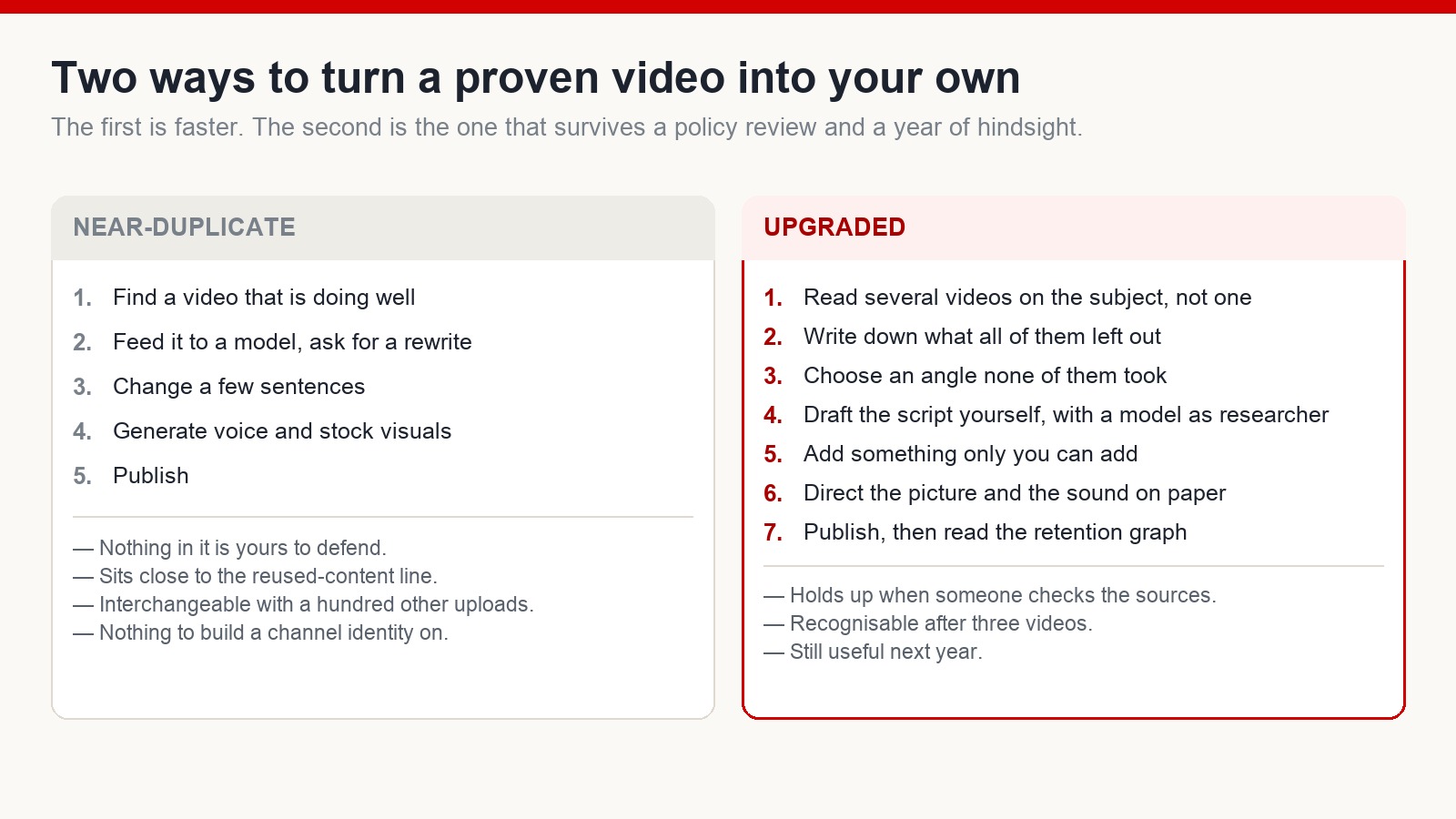
There is a pipeline that has become almost standard on faceless channels. Find a video that is performing. Feed it to a model. Ask for a rewrite. Change a handful of sentences. Generate a voice, drop in stock visuals, publish. Total time, an afternoon.
It is genuinely efficient, and for a while it produces uploads. What it does not produce is a channel that is still working in two years. The creators I know who have been at this the longest do close to the opposite: fewer videos, considerably more time on each one, and almost all of that extra time spent before the editor opens.
This is about the difference between those two approaches to a youtube automation script, and why the slower one tends to be the better trade.
Speed is the wrong thing to optimise
The question most people ask about their process is how to make it faster. It is the wrong question, because the thing being made is not faster or slower, it is better or worse.
Two videos can take the same footage budget, the same voice, the same length, and land completely differently, because one of them has an argument and the other has a summary. Extra hours spent tightening the narration, checking the facts, fixing the running order and directing the pictures are not overhead. They are the part that makes the video worth watching.
An upgraded script starts with analysis, not writing
The most common misunderstanding is that upgrading means writing more. It does not. It means starting somewhere else entirely.
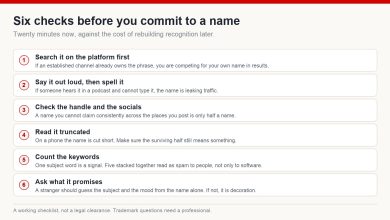
Instead of asking a model to rewrite one video, you read several on the subject and ask harder questions. What did every one of them leave out? What does the comment section keep asking that none of them answered? Which claim do they all repeat that nobody has checked? Is there an angle here that nobody has taken, and if not, is there a better order to tell it in?
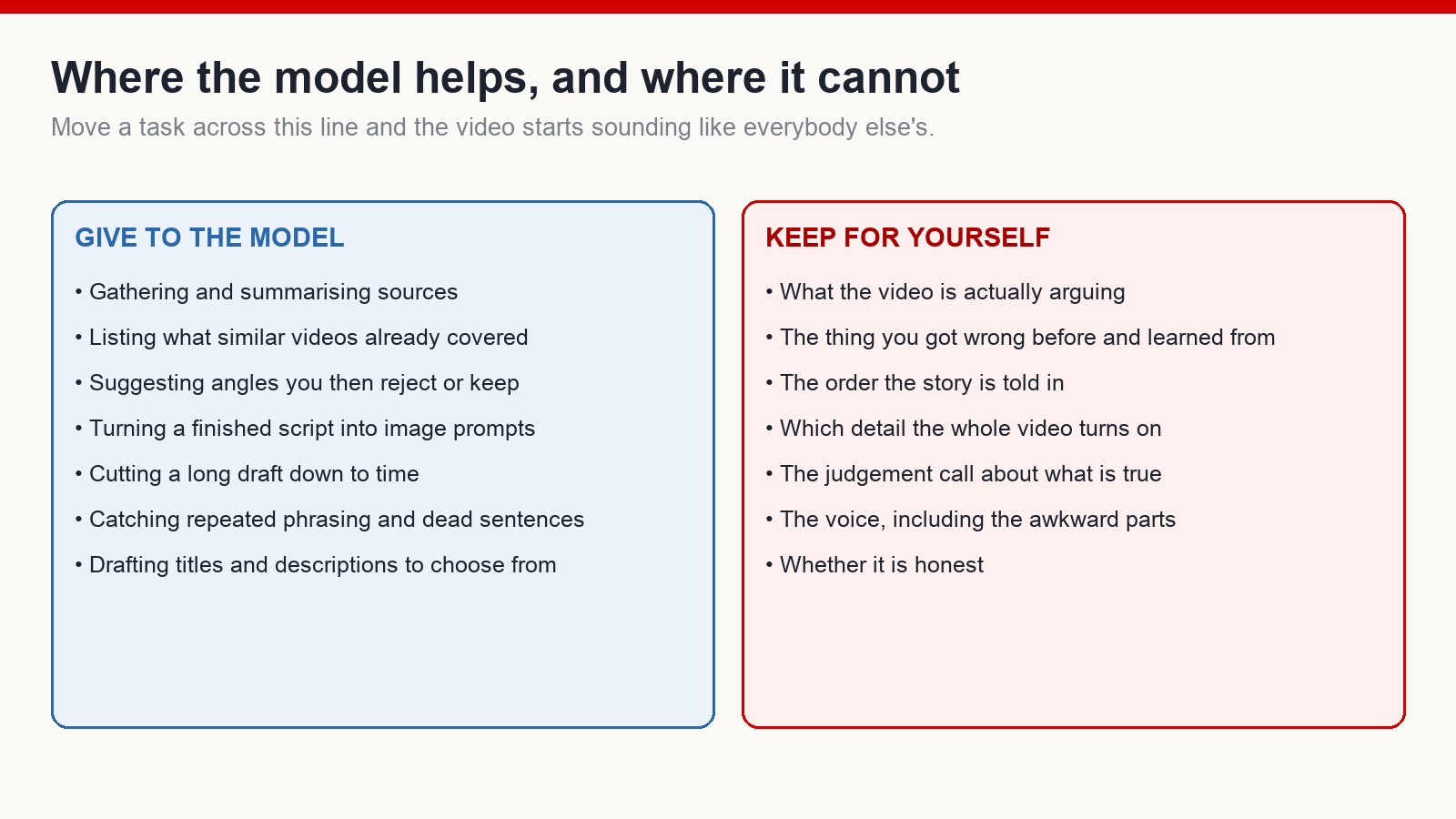
That reframes the model’s job. It stops being a paraphraser and becomes a research assistant. The judgement about what matters stays with you, which is exactly where it has to stay, because it is the only part of the process a viewer can feel.
What “new value” actually means
A video with a few words changed is interchangeable with every other video that changed a few words. There is nothing in it to prefer.
An upgraded video adds at least one thing the source did not have: an analysis rather than a recap, a primary source instead of a secondhand claim, a worked example, a correction, a personal account of getting it wrong, or simply a much better way of explaining the same thing. That is the whole competitive advantage. Not the topic, which anyone can take, but what you did with it.
Why this shows up in the way a channel performs
I want to be careful here, because this is where creator advice usually turns into invented numbers. So, qualitatively.
Videos that hold attention tend to be shown to more people. Viewers who finish something are more likely to watch another. Subjects that attract a specific, engaged audience tend to be worth more to advertisers than subjects that attract nobody in particular, and rates differ enormously by topic, audience country and season. None of that is a formula, and none of it is guaranteed. But the direction is consistent enough to plan around: a video people choose to finish is worth more than one they abandon, whatever units you measure it in.
The volume approach ignores this and bets on quantity instead. The problem is that it competes with everyone else running the same pipeline, on the same topics, with the same tools, and the audience can tell.
There is a policy dimension too
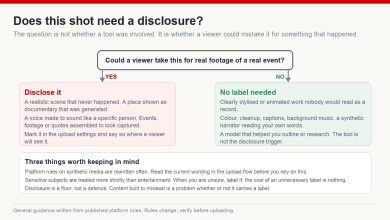
Platforms have become steadily less tolerant of mass-produced, repetitive uploads with little original contribution. Content that is essentially somebody else’s work with a new voice track sits uncomfortably close to that line, and channels built entirely on it are fragile in a way their owners rarely account for until something changes.
Adding real value is not only an audience argument. It is also the thing that makes a channel defensible if it ever gets looked at closely.
The script as a production document
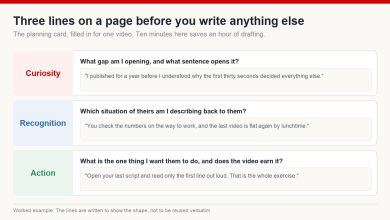
Once the thinking is done, an upgraded script carries more than narration. It usually contains a short statement of what the video is arguing, so that everything downstream stays aligned. It contains the spoken lines, written to be spoken rather than read. It contains a visual instruction for every section, which is what keeps a generated or stock-sourced video from looking like a slideshow of unrelated images. And it contains edit direction: where to cut hard, where to hold, where the music enters and where it stops.
Written that way, the script is the video. Everything after it is assembly.
What the model cannot supply
A model can write a paragraph on any subject in seconds. What it cannot do is have spent three years being wrong about something and then explain what that felt like.
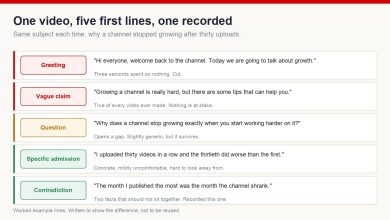
The lines viewers actually remember are the ones no tool would generate: I thought this would work and it did not, this took me far longer than it should have, here is the part I still get wrong. Those are unbeatable precisely because they are not available to anyone else. An upgraded script is not one that hides the fact a model was involved. It is one where a model handled the mechanical work and a person supplied the thinking.
The trade, stated plainly
The near-duplicate pipeline gives you volume and a chance at catching an algorithm on a good day. The upgraded one gives you a smaller number of videos, each of which is worth something on its own, tends to keep working long after publication, and gradually adds up to a recognisable channel.
The second is slower to start and much harder to argue with once it works. The advantage in an era where anyone can generate a video in an afternoon is not being faster than everyone else. It is being worth watching, which is the one thing the tools cannot hand you.
Frequently asked questions
Is a near-duplicate script against the rules?
Repackaging someone else’s work with minimal original contribution risks falling foul of reused and mass-produced content policies. Doing genuinely new work with the same topic does not.
How much longer does an upgraded script take?
Meaningfully longer, and almost all of it is research and structure rather than typing. The exact ratio depends on the niche and how deep the subject is.
Should I use AI at all?
Yes, for research, summarising, image prompts, trimming to length and generating options. Just not for deciding what the video is about or what is true.
Does a better script guarantee better results?
No. Outcomes vary hugely by niche, competition and timing, and platform behaviour changes. It improves the odds and the durability of what you have made, which is a different claim.
If you want the full process for building a faceless channel aimed at English-speaking audiences, that is what I teach at mmoyoutube.com.